Discover / LLM Ops & Observability
TruLens
by trueraPython
Library for evaluating and tracking the performance of LLM applications with feedback functions.
Repositorystable
Maturity: stable because 6y old, trulens-2.10.0 released 62d ago. Derived from release and commit history, not a rating.
- Stars
- 3.6k
- Forks
- 344
- Downloads / mo
- 97k
- Last commit
- 2026-09-26
- License
- MIT
- Open issues
- 80
Market and trust evidence
Edition not yet matchedNo exact skills.sh identity match is available for this repository. Repository adoption and freshness remain visible above; install momentum is not inferred.
Trust analysis is a screening signal, not a security warranty. Read the ranking and trust methodology.
In practice
Written by AI from this repository’s README · high confidenceVibe checking an LLM app gives no record of which prompt, retriever or model version actually performed better.
Use it when
Use it when you want OpenTelemetry spans over your app plus feedback functions scoring each run.
Not the right pick when
Feedback evaluation needs a provider package and model calls, so it adds cost and setup beyond plain tracing.
Capabilities
- OpenTelemetry based tracing of calls, retrievals and tool use
- feedback functions and the RAG triad
- seven agentic evaluators including PlanAdherence and ToolSelection
- inline evaluation while the app runs
- batch evaluation over a dataset with the Run API
- provider packages for OpenAI, Bedrock, Cortex and more
Requirements
- a provider package such as trulens-providers-openai for feedback evaluation
Cost: Free and open source
Install
Derived from the published package name in the repository, not from a model.
Video walkthroughs
Building AI-powered apps with Streamlit and Trulens
Josh Reini – TruEra – Evaluating and Tracking LLM Experiments: Building Better LLM Apps with TruLens
Third-party YouTube uploads matched to this tool by title, channel and repository name on 2026-08-03. Not made, reviewed or endorsed by SkillPilot. View counts and publish months are as of the match date and the month is approximate. Nothing loads from YouTube until you press play.
What the repository ships
Has testsHas docsHas examplesCI configured
Detected from the actual files in the repository root.
Latest release trulens-2.10.0
Published 2026-07-28
TruLens 2.10.0
The judge-quality tooling that 2.9.0 introduced (Jury, CriteriaABTest, ScoreDistributionAnalyzer, GoldenSetGenerator) gets two major additions this release: AlignmentReport and CrossModelAlignment. Together they give you a full diagnostic loop — build a jury, A/B test prompt variants, check score distributions, and now formally measure how well any judge aligns with a ground-truth benchmark and where different models diverge from each other.
OTEL tracing takes another step toward standards compliance with correct SpanKind values per the OpenTelemetry GenAI spec and a new span_group() context manager for localizing metrics to specific pipeline segments. And a new citation_attribution feedback function extends RAG evaluation beyond groundedness to source attribution.
Eight new contributors shipped every feature in this release. The community is building the eval tooling.
New Features
Judge alignment diagnostics
AlignmentReport (#2577 — @furk4neg3)
Measures how well an LLM judge agrees with a ground-truth benchmark dataset. Reports per-label agreement metrics and surfaces systematic biases — e.g. a judge that consistently over-scores low-quality responses. Use it before promoting a judge to CI/CD.
from trulens.benchmark.alignment_report import AlignmentReport

report = AlignmentReport(
    golden_set=golden_data,
    feedback_fn=provider.relevance,
)
report.run().summary()
CrossModelAlignment (#2563 — @thunderstornX)
Runs the same inputs through multiple judge models and reports where they diverge. Practical use: pick the cheapest model whose scores stay within acceptable delta of your reference judge. Complements CriteriaABTest (which tests prompt/config variants against a golden set) — CrossModelAlignment tests model identity.
from trulens.benchmark.cross_model_alignment import CrossModelAlignment

alignment = CrossModelAlignment(
    golden_set=golden_data,
    models=[
        OpenAI(model_engine="gpt-4o"),
        OpenAI(model_engine="gpt-4o-mini"),
        LiteLLM(model_engine="anthropic/claude-3-haiku-20240307"),
    ],
    method="relevance",
)
alignment.run().summary()
New feedback function
citation_attribution (#2576 — @rsrijith)
Evaluates whether an LLM response correctly attributes claims to the provided source material. Distinct from groundedness (is the answer factually supported?) — citation attribution asks whether sources are explicitly and accurately credited. Rounds out the RAG triad with a fourth attribution dimension.
from trulens.core import Metric
from trulens.feedback.templates.rag import CitationAttribution

f_citation = Metric(
    implementation=provider.citation_attribution,
    name="Citation Attribution",
).on_context().on_output()
OTEL tracing improvements
SpanKind per OpenTelemetry GenAI conventions + resource attributes (#2633 — @Payal2000)
Instrumented spans now emit correct SpanKind values (e.g. CLIENT for LLM calls) and include resource attributes aligned with the OTel GenAI semantic specification. Improves out-of-the-box compatibility with OTEL-native observability backends (Jaeger, Honeycomb, Grafana Tempo, etc.).
span_group() context manager for per-segment metric localization (#2637 — @Payal2000)
Groups spans within a logical segment so feedback functions can target a specific step rather than the full trace. Useful for multi-turn pipelines where you want turn-level quality scores, or multi-stage pipelines where you want stage-level evals.
from trulens.core.otel.instrument import span_group

with span_group("retrieval_step"):
Tags
README
🦑 Welcome to TruLens!
Don't just vibe-check your LLM app! Systematically evaluate and track your
LLM experiments with TruLens. As you develop your app including prompts, models,
retrievers, knowledge sources and more, TruLens is the tool you need to
understand its performance.
Fine-grained, stack-agnostic instrumentation and comprehensive evaluations help
you to identify failure modes & systematically iterate to improve your
application.
Read more about the core concepts behind TruLens including Feedback Functions,
and Honest, Harmless and Helpful Evals.
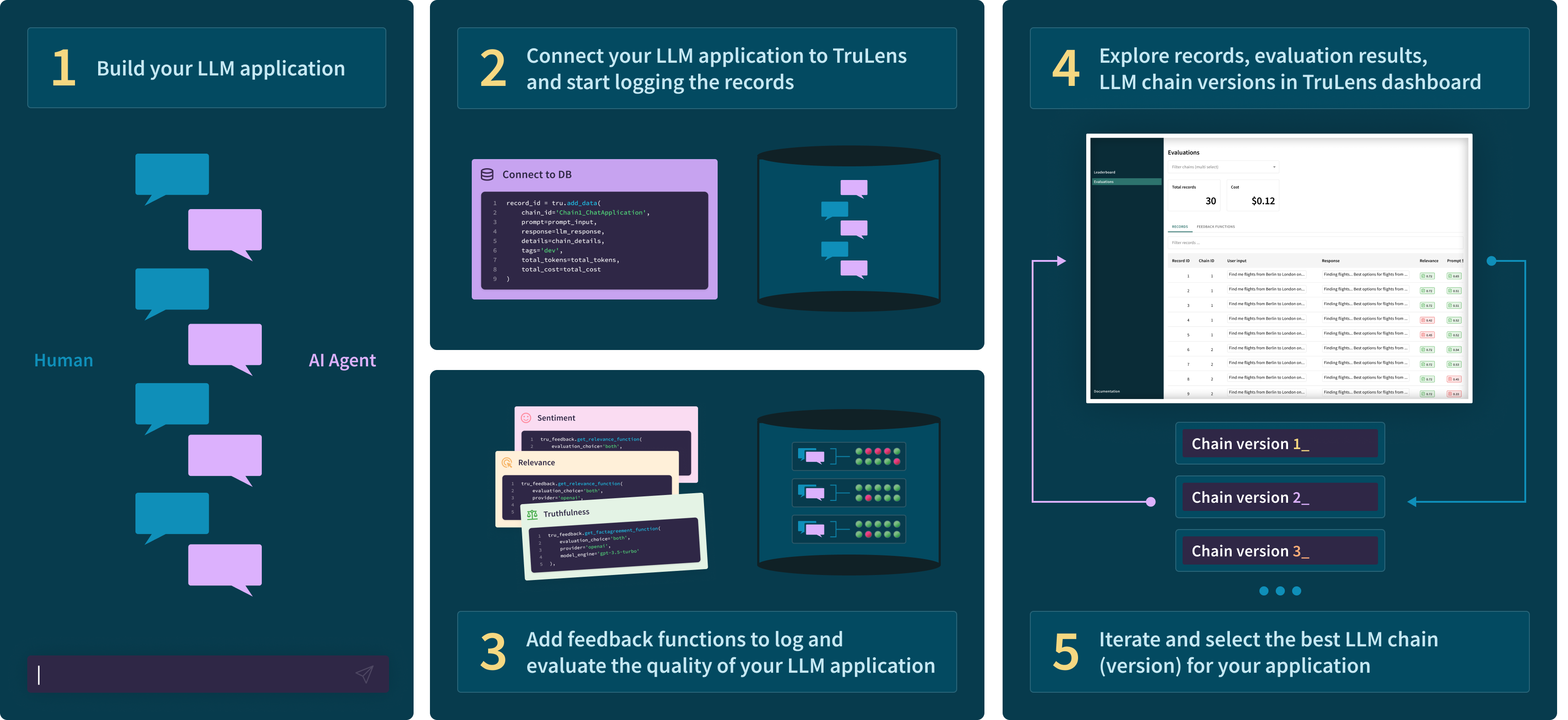
TruLens in the development workflow
Build your first prototype then connect instrumentation and logging with
TruLens. Decide what feedbacks you need, and specify them with TruLens to run
alongside your app. Then iterate and compare versions of your app in an
easy-to-use user interface 👇
Installation and Setup
Install the trulens pip package from PyPI.
pip install trulens-core
Install with a specific LLM provider for feedback evaluation:
pip install trulens trulens-providers-openai   # OpenAI / Azure OpenAI
pip install trulens trulens-providers-litellm  # LiteLLM (Anthropic, Cohere, Mistral, …)
pip install trulens trulens-providers-google   # Google Gemini
pip install trulens trulens-providers-bedrock  # AWS Bedrock
pip install trulens trulens-providers-cortex   # Snowflake Cortex
pip install trulens trulens-providers-huggingface  # HuggingFace
pip install trulens trulens-providers-langchain    # LangChain models
Install with a specific app framework integration:
pip install trulens trulens-apps-langchain    # LangChain / LangGraph
pip install trulens trulens-apps-llamaindex  # LlamaIndex
Quick Usage
Walk through how to instrument and evaluate a RAG built from scratch with
TruLens.
[](https://colab.research.google.com/github/truera/trulens/blob/main/examples/quickstart/quickstart.ipynb)
Key Features
🔭 OpenTelemetry-based tracing
TruLens instrumentation is built on OpenTelemetry.
Every function call, LLM generation, retrieval, and tool invocation is captured
as a structured OTEL span. This makes TruLens interoperable with existing
observability infrastructure — export traces to Jaeger, Grafana Tempo, Datadog,
or any OTLP-compatible backend.
from trulens.core.otel.instrument import instrument
from trulens.otel.semconv.trace import SpanAttributes

class MyRAG:
    @instrument(
        span_type=SpanAttributes.SpanType.RETRIEVAL,
        attributes={
            SpanAttributes.RETRIEVAL.QUERY_TEXT: "query",
            SpanAttributes.RETRIEVAL.RETRIEVED_CONTEXTS: "return",
        },
    )
    def retrieve(self, query: str) -> list:
        ...
🤖 Agentic evaluations
Seven purpose-built evaluators for agentic systems — each measuring a distinct
aspect of agent behavior:
| Evaluator | What it measures |
|-----------|-----------------|
| LogicalConsistency | Reasoning coherence; flags hallucinations and unsupported assertions |
| ExecutionEfficiency | Redundant steps, unnecessary retries, wasted computation |
| PlanAdherence | Whether execution followed the stated plan |
| PlanQuality | Intrinsic plan quality — strategy, not outcome |
| ToolSelection | Right tool chosen for each subtask |
| ToolCalling | Argument validity and output interpretation |
| ToolQuality | External tool/service reliability |
📊 Batch and inline evaluation
Run evaluations alongside your app, on existing data, or in offline batch mode:
# Inline — evaluate as the app runs
with tru_recorder as recording:
    response = my_app.query("What is TruLens?")

# Batch — evaluate a pre-collected dataset using the TruLens 2.8 Run API
from trulens.core.run import RunConfig

run_config = RunConfig(
    run_name="batch_eval_v1",
    dataset_name="eval_questions",
    source_type="TABLE",
    dataset_spec={"input": "QUESTION"},
    invocation_max_workers=8,
    metric_max_workers=4,
)
run = tru_app.add_run(run_config=run_config)
run.start()
run.compute_metrics([relevance, groundedness])
🔌 MCP support
Instrument Model Context Protocol tool calls
with the MCP span type to capture tool name, arguments, output, and latency:
@instrument(span_type=SpanAttributes.SpanType.MCP)
def call_mcp_tool(self, tool_name: str, arguments: dict) -> str:
    ...
🎯 Selector API
Target any span attribute for evaluation using the flexible Selector API:
from trulens.core import Metric, Selector

f_context_relevance = Metric(
    name="Context Relevance",
    implementation=provider.context_relevance,
    selectors={
        "input": Selector.select_record_input(),
        "context": Selector.select_context(),
    },
)
Supported LLM Providers
| Provider | Package |
|----------|---------|
| OpenAI / Azure OpenAI | trulens-providers-openai |
| LiteLLM (Anthropic, Cohere, Mistral, and more) | trulens-providers-litellm |
| Google Gemini | trulens-providers-google |
| AWS Bedrock | trulens-providers-bedrock |
| Snowflake Cortex | trulens-providers-cortex |
| HuggingFace | trulens-providers-huggingface |
| LangChain models | trulens-providers-langchain |
💡 Contributing & Community
Interested in contributing? See our [contributing
guide](https://www.trulens.org/contributing/) for more details.
The best way to support TruLens is to give us a ⭐ on
GitHub and join our [discourse
community](https://snowflake.discourse.group/c/ai-research-and-development-community/trulens/97)!